By Adam Swift
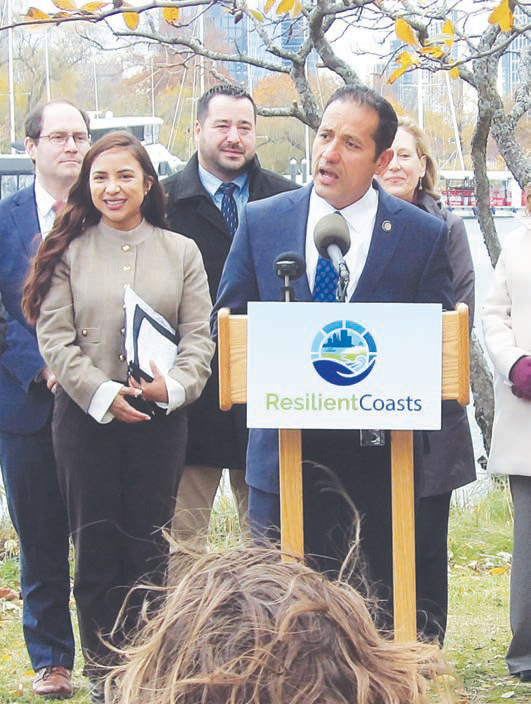
Chelsea City Manager Fidel Maltez highlights how the new state ResilientCoasts Plan will benefit Chelsea while state Representative Judith Garcia look on.
Last week, the Healey-Driscoll Administration released the final ResilientCoasts Plan – a comprehensive statewide strategy designed to help coastal communities protect residents, strengthen local infrastructure, and safeguard Massachusetts’ natural resources.
State Energy and Environmental Affairs Secretary helped unveil the plan in Chelsea on Thursday, Nov. 6 at Island End River Park, joined by city and state leaders and local stakeholders.
Developed with direct input from local officials, residents, and regional partners, the plan provides practical, community-driven steps to prepare for future storms, flooding, sea level rise, and erosion – while saving taxpayers billions through smart investments made now.
“Our coastal communities can’t wait for the next big storm to act,” said Tepper. “This plan gives us the tools to be ready – to protect lives, homes, and local economies and to build the kind of resilience that will carry us through the next 50 years.”
Tepper said research shows that every $1 invested in resilience can yield about $13 in benefits and avoided recovery costs, and communities that delay action risk losing up to $33 in future economic activity for every dollar not invested. The ResilientCoasts Plan supports cities and towns in planning and prioritizing the projects that matter most – stronger shorelines, better storm protection, and safer roads.
The plan is designed to support local decision-making and make it easier for towns and regions to access funding, share data, and coordinate projects. It lays out the steps to protect people and property, strengthen infrastructure, and preserve natural buffers like dunes, wetlands, and salt marshes that reduce flood risks.
“Chelsea stands with Secretary Tepper and the Healey-Driscoll Administration on a forward-thinking plan to protect our communities against flooding, which is becoming increasingly devastating year-after-year,” said Chelsea City Manager Fidel Maltez. “The ResilientCoasts Plan recognizes that by investing in places like the Island End River floodplain—a working waterfront threatened by rising sea levels and extreme weather—we are protecting the lives of thousands of residents, $7 billion in annual economic activity, and the region’s food supply. The plan is an urgent call to strengthen our shores today and avoid the staggering costs of recovery tomorrow.”
Over the past two decades, Massachusetts has invested nearly $200 million in local resilience projects across 98 coastal communities. Governor Healey’s Mass Ready Act advances many ResilientCoasts recommendations, including authorizing $200 million for near-term coastal resilience projects, according to state officials.
In addition, Mass Ready moves forward several of the plan’s policy recommendations that will also advance resilience statewide, including requiring flood disclosure to ensure residents are aware of flood risks before they purchase or lease a home, adding resilience expertise to the board that oversees updates to the state building code, streamlining permitting for nature-based solutions, and creating a new Resilience Revolving Fund to provide low-interest loans for municipal projects that protect communities and prevent future damage, such as floodplain protection and nature-based solutions.
“Climate change is creating severe and frequent natural disasters across our state, and it is essential that we pull together resources, coordinate projects, and leverage all the powers of state government to protect our communities and residents from severe flood risks over the coming years,” said state Senator Sal DiDomenico. “This ResilientCoasts Initiative will be critical in both addressing the dangers posed by the climate crisis in a holistic approach, while simultaneously making our communities safer and more welcoming for all our residents.”
Salem Mayor Dominick Pangallo, who was on hand for the event in Chelsea, said investments in resilience are investments in public safety, and they require collaboration between neighboring municipalities, across regions, and throughout the Commonwealth.
“No one community can face this tide alone,” he said.
The plan identifies 15 Coastal Resilience Districts, grouping nearby cities and towns that share common characteristics like landform type, natural environment, built infrastructure, population and development character, and coastal risks. The purpose of these districts is to promote regional collaboration, inform prioritization of district-scale coastal resilience projects, and help prevent redundant efforts. In addition, data sharing, collaborative risk assessment, and tracking of progress on coastal resilience will be improved across communities.
“We heard directly from residents, scientists, and local officials across our coast, and their input shaped every part of this plan,” said Coastal Zone Management Director Alison Brizius. “People see what’s happening – the flooding, the erosion, the stronger storms – and they want action. ResilientCoasts reflects that urgency and provides a framework for protecting our coastlines and fighting climate impacts head-on.”
Within the Coastal Resilience Districts, the plan identifies Near-Term Adaptation Areas with high concentrations of people and housing, development and infrastructure, and/or economic resources expected to be exposed to coastal flooding by the 2030s. Identification of these areas helps direct limited resources where they will make the biggest difference for residents and local economies – for example, in areas with high concentrations of critical local and regional infrastructure at risk.
The plan provides guidance on a suite of resilience measures that can be applied across different coastal landscapes with a focus on areas along the immediate shoreline or within the coastal floodplain where the highest risks coincide with vulnerable development.
“Coastal resilience is essential to the long-term safety and economic vitality of communities like Chelsea,” said state Representative Judith Garcia. “The ResilientCoasts Plan reflects a forward-looking, coordinated approach to protecting our infrastructure, homes, and natural resources. I’m proud that Chelsea is part of this statewide effort to strengthen our coastlines and prepare for the challenges ahead. I want to thank the Healey-Driscoll Administration, Secretary Tepper, and their team for their continued partnership and commitment to building a more resilient Massachusetts.”
John Lucero, the general manager of the nearby New England Produce, highlighted the importance of working together with the state and the local communities for coastal resilience measures, noting that if the New England Produce Center were forced to shut down because of flooding, it would negatively impact the distribution of food for millions of meals per day for the Northeast and parts of Canada.
“Without the flood barrier, it is only a matter of time,” Lucero said. “An interruption of service would be absolutely devastating to the region, our economy, and the health of 9 million people. If we shut down, in two days, grocery store shelves would look empty and people would panic, like they did for toilet paper in 2020, and buy more and more until there was nothing left.”
GreenRoots Executive Director Roseanne Bongionvanni said GreenRoots was thrilled to be part of the external task force providing input for the Coastal Resiliency report.
“We in Chelsea and East Boston know the importance of preparing for future climate impacts,” said Bongiovanni. “We see the beginnings of these impacts every single day in frontline environmental justice communities like Chelsea and East Boston. From sunny day flooding in the Shaw’s parking lot in East Boston to Marginal Street and Eastern Ave. in Chelsea filling up with seawater during the winter storms of 2018 … our residents and our municipal authorities are experiencing these effects now, and are looking to the state and our federal government, which has abandoned us, for funding for these critical situations.”